
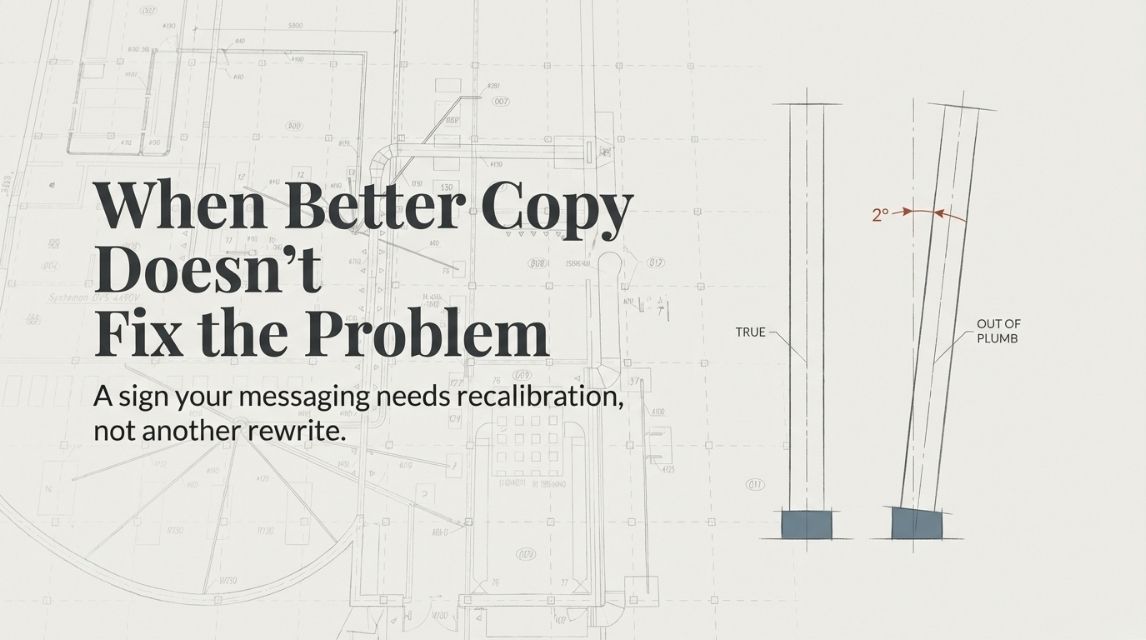
If you’ve rewritten your messaging multiple times and it still doesn’t feel right, the issue probably isn’t the copy.
The words may be clear. Structure may be sound. Tone may even be “on brand.” And yet, something continues to resist settling. Each revision improves the surface, but the underlying tension remains.
This is often the point where teams assume they just haven’t found the right version yet. One more pass, one more angle, one more attempt to sharpen what’s already there.
But when rewriting stops producing relief, it’s usually a sign that the problem lives somewhere else.
The quiet frustration of fixing what isn’t broken
Most organizations encounter this moment quietly.
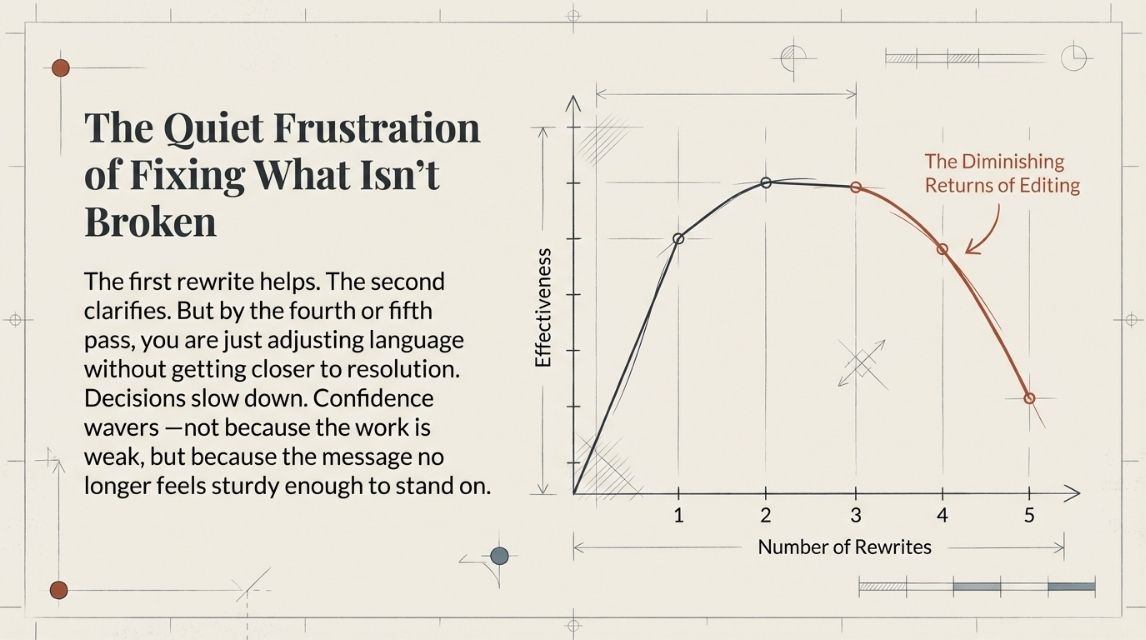
It starts with diminishing returns. The first rewrite helps, the second clarifies, the third feels marginal. By the fourth or fifth pass, people are adjusting language without feeling any closer to resolution. Decisions slow down. Confidence wavers — not because the work is weak, but because the message no longer feels sturdy enough to stand on.
What makes this frustrating is that nothing is obviously broken. The messaging still “works” in a technical sense. It communicates the offering. It reflects stated values. It follows best practices. From the outside, it may even perform well.
Internally, messaging feels strained.
Teams hesitate before publishing. Leaders second-guess language they once trusted. Promotion starts to feel heavier than it should, even when the work itself is strong.
That’s usually when the cycle begins: rewrite, refine, repeat.
Why another rewrite feels like the responsible thing to do
Rewriting is appealing because it promises control.
If the issue is language, then the solution is effort: more clarity, better phrasing, sharper positioning. Rewriting suggests that alignment can be restored through precision alone—that the right words will unlock confidence and momentum again.
And sometimes, that’s true.
When the problem is genuinely about clarity — unclear value, fuzzy differentiation, inconsistent tone — rewriting can be exactly what’s needed. A clean edit resolves the tension, and the message settles.
But when rewriting doesn’t work, it’s often because the discomfort isn’t coming from how something is being said. It’s coming from what the language is being asked to carry.
The point where clarity stops being the issue
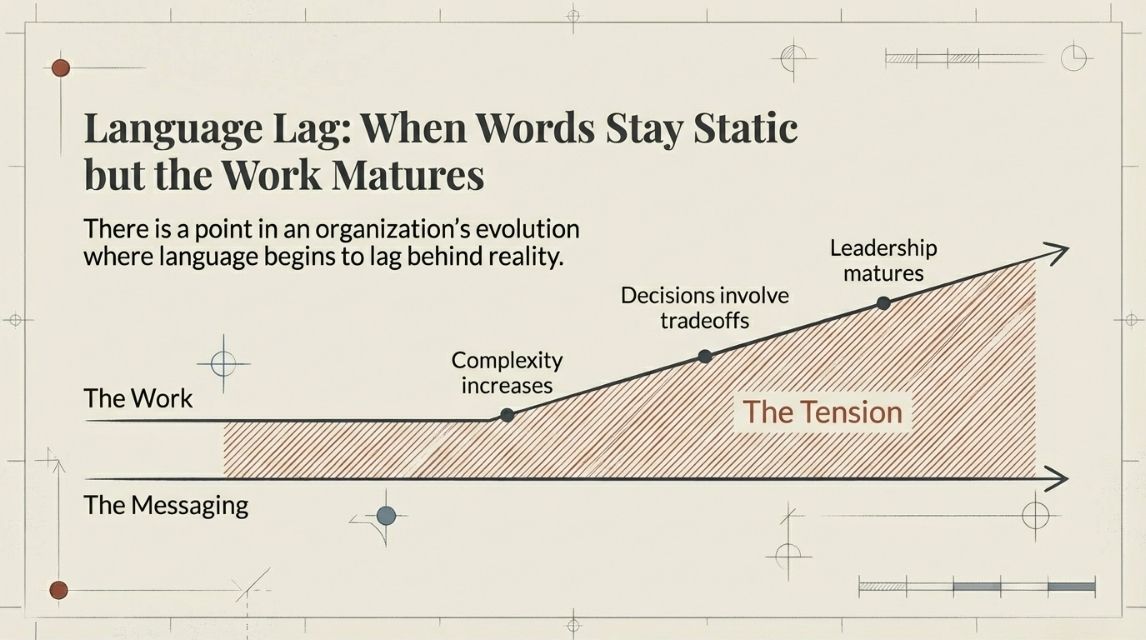
There’s a point in an organization’s evolution where language begins to lag behind reality:
- The work becomes more complex.
- Decisions involve more tradeoffs.
- Responsibility increases. Leadership matures.
- The organization starts operating with a deeper internal logic — one shaped by experience, judgment, and long-term consequences rather than aspiration alone.
Rewriting as compensation
When messaging continues to describe the work as if it hasn’t changed, rewriting becomes an act of compensation. Teams try to stretch familiar language to cover new weight. They add nuance, qualifiers, or emphasis to words that were never meant to hold this version of the work.
No amount of refinement resolves that mismatch. The problem isn’t that the words are wrong. It’s that they’re no longer sufficient.
When the problem isn’t wording — it’s weight
This is where the difference between rewriting and recalibration matters.
Rewriting works at the sentence level. It improves clarity, flow, and precision within an existing frame. Recalibration works at the meaning level. It asks whether the frame itself still reflects how the organization actually operates now.
Recalibration involves stepping back far enough to examine how decisions are made, what’s being prioritized, and what responsibility looks like in practice. It reconnects language to lived reality before attempting to refine expression.
When recalibration happens first, rewriting becomes efficient again. The words no longer have to compensate for misalignment. They’re free to describe what’s already true.
The moment language can’t stretch any further
There’s usually a moment when teams realize they’re no longer improving the message — they’re just redistributing the strain.
A limit, not a failure
The language starts to feel stretched. Each revision pulls a little further. Every new qualifier asks the words to accommodate more complexity than they were shaped for. The material hasn’t torn, but it no longer relaxes back into place.
The message still works. It just doesn’t rest easily anymore, because it’s being asked to hold more than it was originally cut for.
- Long-standing language + meaning erosion. The words still exist everywhere, but they no longer surface the thinking behind the work. They describe outcomes without conveying the care, tradeoffs, or judgment that now define how those outcomes are achieved.
- Values expressed differently over time. The language points to the right ideals, but it reflects an earlier expression of them — one that no longer captures the complexity of how the organization operates today.
- Increased responsibility. The message continues to speak in terms of benefit or capability, while the work itself now requires discernment, restraint, and accountability that the language never acknowledges.
These are the moments when rewriting stops relieving pressure and starts redistributing it. Language can’t stretch any further because the frame itself needs to change.
What returns when language matches lived reality
What returns first isn’t enthusiasm or momentum. It’s relief.
- Internally, decisions feel easier to stand behind — not because there’s less uncertainty, but because the language now reflects the reasoning already happening inside the organization. Teams stop translating between what they know to be true and what the message allows them to say. That gap quietly closes.
- Externally, the message gains credibility without needing more emphasis. It signals judgment and care rather than performance. Internally, it reduces friction. Language starts supporting the work instead of competing with it.
This isn’t about making the message louder or more compelling. It’s about restoring its ability to carry the truth of the work — without strain. When language matches lived reality, people stop bracing against it. It becomes shared ground again.
The doubts that surface right before things clarify
At this point, many teams wonder whether this means starting over. It usually doesn’t.
Recalibration rarely requires abandoning what’s already been built.
More often, it involves examining what the organization now knows — and allowing that understanding to inform how the work is described.
Others worry this is simply messaging fatigue. But fatigue tends to pass. Misalignment persists.
The key difference is whether the discomfort resolves with rest — or returns every time the message is put back into use.
A simple way to tell what kind of problem this is
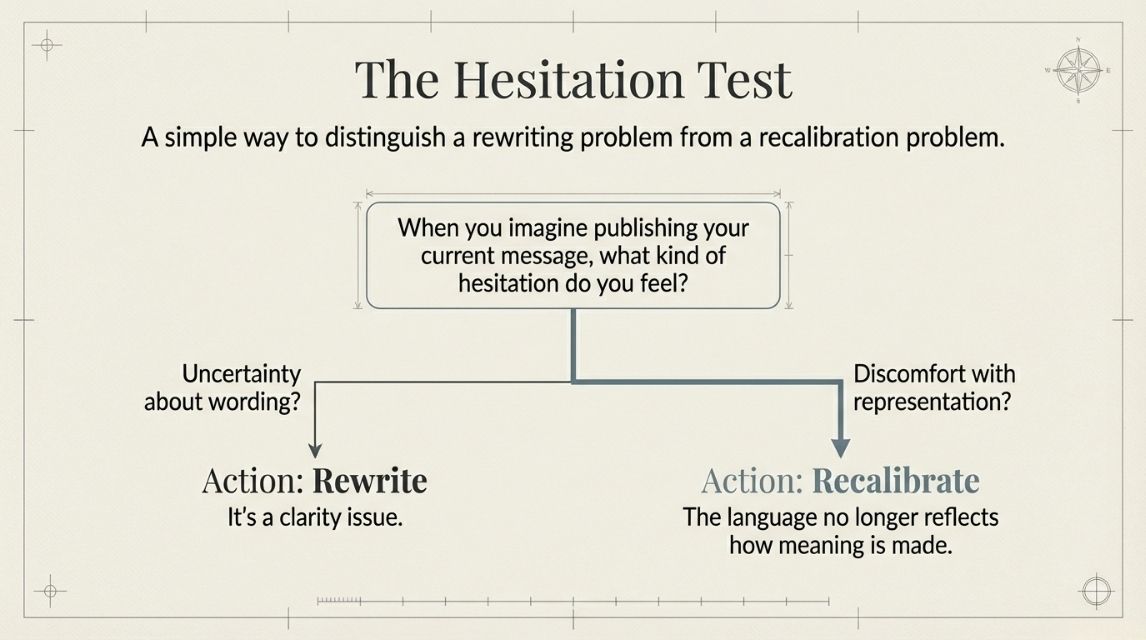
A simple test can help distinguish between a rewriting problem and a recalibration problem:
When you imagine publishing your current message, does the hesitation feel like uncertainty about wording — or discomfort with representation?
If it’s the former, rewriting may help.
If it’s the latter, it’s usually a sign that the language no longer reflects how meaning is being made inside the organization.
The cost of working around misalignment
Friction, not failure
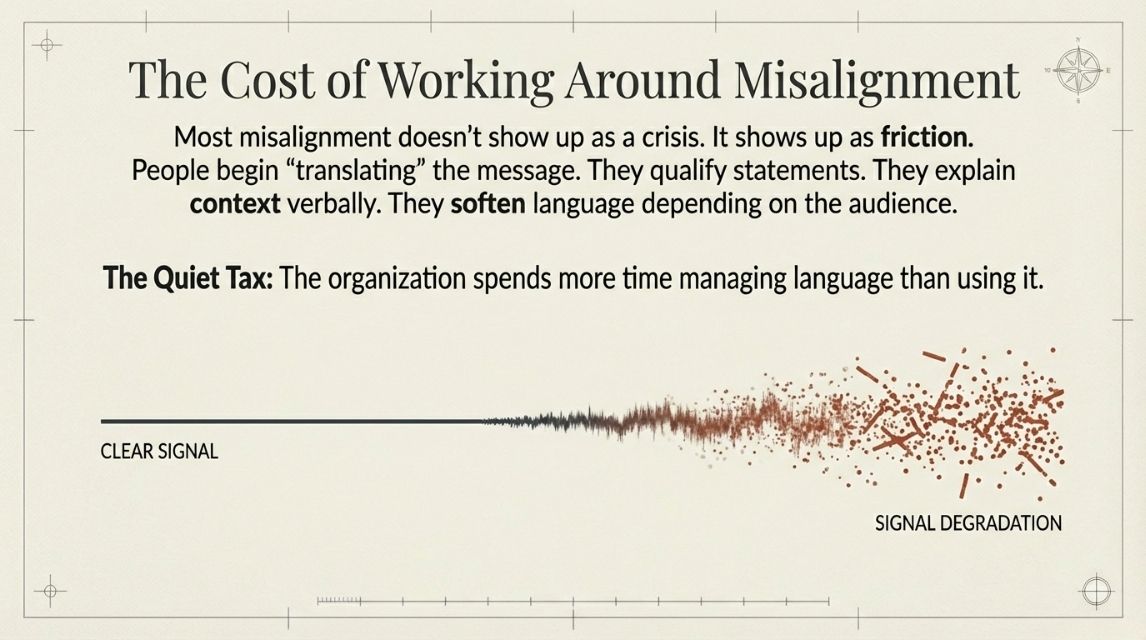
Most misalignment doesn’t show up as a crisis. It shows up as friction.
When the message no longer quite fits, people begin working around it. They qualify statements in meetings. They explain context verbally. They soften or sharpen language depending on the audience. None of this feels wrong — it feels responsible.
How inconsistency forms
Over time, those small adjustments add up. The message stops being a shared reference point and starts behaving more like a suggestion. Everyone is technically saying the same thing, but in slightly different ways, with slightly different emphasis. The language fragments — not out of disagreement, but out of necessity.
The quiet tax
This is how inconsistency takes hold. Not because teams lack alignment, but because the official language no longer carries the full meaning of the work. People compensate by translating it themselves. Each translation makes sense in isolation. Collectively, they blur the signal.
Eventually, messaging becomes something people explain around instead of rely on. Decisions take longer to communicate. Confidence becomes situational rather than shared. The organization spends more time managing language than using it — a quiet tax that compounds as the work grows more complex.
Why this becomes a leadership issue
When that happens, the issue is no longer how the message sounds. It’s how leadership functions. Shared language is what allows judgment to scale, alignment to hold, and responsibility to be carried consistently across a team.
That’s why recalibration isn’t a branding exercise. It’s a leadership one.
If this feels familiar, here’s the right next step
If rewriting hasn’t resolved the tension you’re feeling, it’s likely because the work has evolved and the language hasn’t been given space to evolve with it.
This is the stage where recalibration becomes more useful than refinement — where reconnecting language to lived decision-making restores clarity and confidence.
I work with legacy businesses and leadership teams at this point of growth to realign messaging with values, responsibility, and direction, so language can once again support the work instead of straining to keep up with it.
If you’re noticing this pattern in your organization, it may be time to slow down and recalibrate the language carrying the work. Explore my services →